
High-Pressure Briquetting Machine Empowers Efficient Powder Material Forming and Promotes Green Production
- 2026-02-26 14:35:00
- E.P Original
- 364
In the field of powder and granular material forming, briquetting equipment is one of the core machines widely used in metallurgy, mining, chemical engineering, building materials, and environmental protection industries. With increasing demands for environmental compliance, resource recycling, and high value-added products, high-pressure briquetting machines have become a key solution for optimizing industrial production processes due to their high forming strength, operational stability, and continuous production capability.
High-Pressure Forming for Improved Material Utilization
A high-pressure briquetting machine typically refers to equipment with a line pressure of 5–12 t/cm. Common specifications include 80 kN/cm, 110 kN/cm, 120 kN/cm, and 150 kN/cm. Line pressure, defined as the pressure per unit width of the pressing surface, is the core technical parameter for evaluating forming capacity. Through briquetting tests and material analysis, the appropriate line pressure can be determined to ensure an optimal balance between briquette strength and production efficiency.
During operation, powder materials are compressed and formed between two counter-rotating rollers. One roller is movable and applies pressure through a hydraulic system. Customized molds are installed on the roller surfaces to meet different briquette shape requirements. The material may consist of a single component or a mixture. For materials with insufficient natural bonding strength, suitable binders such as starch, bentonite, asphalt, quicklime, cement, lignosulfonate, molasses, polymers, or composite binders can be added to improve briquetting performance.
Scientific Equipment Selection for Optimal Performance
Selecting the appropriate high-pressure briquetting machine mainly depends on three key factors:
- Required line pressure – Determined through material testing;
- Production capacity – Used to preliminarily select roller diameter and width;
- Briquette shape and size – Different shapes significantly affect output and are typically proposed by the end user and optimized by the manufacturer.
Continuous Quantitative Process for Stable Production
The core principle of briquetting technology is “continuous and quantitative feeding.” Since different materials vary in fineness, particle size distribution, moisture content, and chemical composition, briquetting performance can differ significantly. Therefore, preliminary testing is usually required to determine the most suitable process parameters.
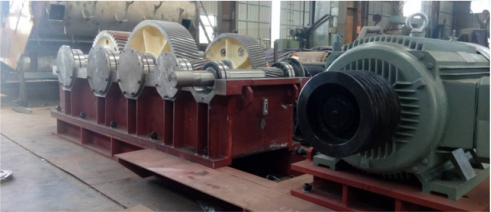
A complete production line generally includes continuous batching, mixing, briquetting, and, if necessary, drying stages to ensure product strength and appearance quality. For materials with poor flowability, high abrasiveness, or low formability, specially designed variable-pitch pre-press screws with cleaning and extrusion functions can significantly improve briquetting efficiency. This technology has become one of the core competitive advantages of high-pressure briquetting systems.
Optimized Structure for Durable and Reliable Operation
High-pressure briquetting machines are engineered for long-term stable operation:
- The transmission system adopts a configuration of motor – elastic coupling (or belt drive) – dual-output shaft reducer – gear coupling – twin rollers, ensuring stable power transmission;
- Roller assembly options include hot-mount structures, detachable expansion sleeves, and segmented roller shell structures for easier maintenance;
- Roller materials include high-quality bearing steel, cold-work tool steel, and martensitic stainless steel (suitable for acidic materials);
- Bearings are installed with withdrawal sleeve structures and dedicated tools for convenient disassembly and maintenance.
Wide Application and Support for Green Recycling
High-pressure briquetting machines are suitable for a wide range of materials, including:
- Minerals: bauxite, limestone, dolomite, magnesia, fluorite, laterite nickel ore, etc.;
- Metallic mineral powders: chrome ore fines, manganese ore fines, ferronickel powder, silicomanganese alloy fines, etc.;
- Direct reduced iron (DRI) cold briquettes;
- Various dust collection residues (electric furnace dust, converter dust, blast furnace dust, sinter fines, coke breeze, etc.);
- Coal, carbon black, graphite, charcoal, and carbon-containing pellets.
As environmental regulations become stricter and the demand for comprehensive resource utilization increases, high-pressure briquetting machines are evolving from standalone forming equipment into integrated and automated system solutions. With complete electrical interlocking and interface control systems, turnkey projects can be delivered to meet specific customer requirements.
In the future, high-pressure briquetting technology will play an increasingly important role in energy saving, solid waste recycling, and high-strength material forming, providing more efficient, stable, and environmentally friendly solutions for modern industry.
+86-185 6888 1755
Telephone
+86-371-8611808
hank@ep-machine.com
Address
Shenglongjinzhonghuan Building, Zhongyuan District Zhengzhou City, Henan Province, China.
 hank@ep-machine.com
 +86 185 6888 1755
 Get A Quote
